What is the plural form of the word "file shredder"? The plural form (meaning multiples) of the base word "file shredder" is "file shredders." Nouns can identify places, people, animals, and other things. They are the basic materials required to construct sentences. There are different types of nouns, including proper nouns, common nouns, compound nouns, collective nouns, abstract nouns, and countable and uncountable nouns.
What is the plural of File Shredder?
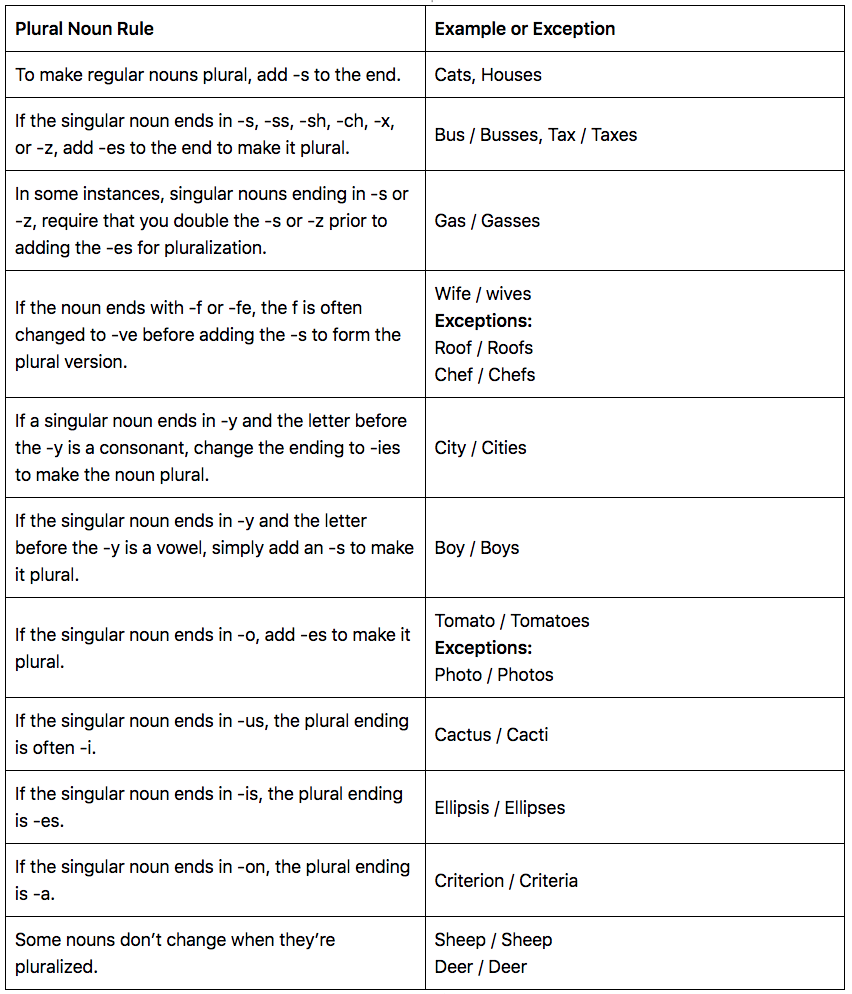
The plural form of the word "file shredder" is "file shredders". Forming plural nouns can be difficult. To form the plural form of the word, you'll base it on the last letter or last two letters of the singular word form.
The word "file shredder" is considered a common noun.
Sentence examples for the plural of "File Shredder"
- Example 1: There are multiple file shredders.
- Example 2: I can see multiple file shredders.
- Example 3: Over there could be more file shredders.
For more examples, see the definition of the word file shredder.
My experience with plural forms...
When it comes to plural forms, I was always confused! Just like you, I would be looking up the singular words plural formation...
Here are some really simple tricks that helps me remember plural forms:
- Did you know that most plurals are formed by adding an -s to the end of the word? Yes!
- If the noun ends in a consonant plus "–y," form the plural by swapping the "–y" for "–ies."
- If the noun ends in "–ch," "-s," "-sh," "-x," or "-z," form the plural by adding "–es."

Fact checked:
Content is rigorously reviewed by a team of qualified and experienced fact checkers. Fact checkers review articles for factual accuracy, relevance, and timeliness. Learn more.

Core lessons
Glossary
- Abstract Noun
- Accusative Case
- Anecdote
- Antonym
- Active Sentence
- Adverb
- Adjective
- Allegory
- Alliteration
- Adjective Clause
- Adjective Phrase
- Ampersand
- Anastrophe
- Adverbial Clause
- Appositive Phrase
- Clause
- Compound Adjective
- Complex Sentence
- Compound Words
- Compound Predicate
- Common Noun
- Comparative Adjective
- Comparative and Superlative
- Compound Noun
- Compound Subject
- Compound Sentence
- Copular Verb
- Collective Noun
- Colloquialism
- Conciseness
- Consonance
- Conditional
- Concrete Noun
- Conjunction
- Conjugation
- Conditional Sentence
- Comma Splice
- Correlative Conjunction
- Coordinating Conjunction
- Coordinate Adjective
- Cumulative Adjective
- Dative Case
- Determiner
- Declarative Sentence
- Declarative Statement
- Direct Object Pronoun
- Direct Object
- Diction
- Diphthong
- Dangling Modifier
- Demonstrative Pronoun
- Demonstrative Adjective
- Direct Characterization
- Definite Article
- Doublespeak
- False Dilemma Fallacy
- Future Perfect Progressive
- Future Simple
- Future Perfect Continuous
- Future Perfect
- First Conditional
- Irregular Adjective
- Irregular Verb
- Imperative Sentence
- Indefinite Article
- Intransitive Verb
- Introductory Phrase
- Indefinite Pronoun
- Indirect Characterization
- Interrogative Sentence
- Intensive Pronoun
- Inanimate Object
- Indefinite Tense
- Infinitive Phrase
- Interjection
- Intensifier
- Infinitive
- Indicative Mood
- Participle
- Parallelism
- Prepositional Phrase
- Past Simple Tense
- Past Continuous Tense
- Past Perfect Tense
- Past Progressive Tense
- Present Simple Tense
- Present Perfect Tense
- Personal Pronoun
- Personification
- Persuasive Writing
- Parallel Structure
- Phrasal Verb
- Predicate Adjective
- Predicate Nominative
- Phonetic Language
- Plural Noun
- Punctuation
- Punctuation Marks
- Preposition
- Preposition of Place
- Parts of Speech
- Possessive Adjective
- Possessive Determiner
- Possessive Case
- Possessive Noun
- Proper Adjective
- Proper Noun
- Present Participle
- Prefix
- Predicate